Buying Your First Suit: A Guide for Students and Young Professionals
Choose a first suit around real occasions, an all-in budget and fit. Compare borrowing, rental, ready-made and custom options, with examples on young clients.
Published by Wuyue Bespoke Tailoring, with university career-service references and real client examples. This guide considers both ready-made and custom options.
Before you buy
Start with the occasion, the whole outfit and the fit
- First decision
- Find out whether the event actually calls for a suit
- Useful starting colours
- Navy or charcoal when several occasions need to be covered
- Budget
- Include shirt, shoes, alterations and delivery where needed
- At the fitting
- Sit, walk and reach while wearing the intended shirt and shoes
Before buying your first suit, identify the next occasions when you expect to wear it. An interview, graduation ceremony, weekly client meeting and black-tie wedding may call for different clothes. The most useful purchase is the one that fits those actual situations and leaves enough money to complete the outfit.
If you need a conventional suit for several occasions, a navy or charcoal two-piece is a practical starting point. Try ready-made options as well as considering custom tailoring. If the need is a single event and the budget is tight, borrowing, renting or using a university clothing programme may solve the problem with less expense.
Do you need to buy a suit yet?
Read the invitation or ask the organiser, recruiter or career adviser about the expected dress. Harvard's career-service guidance distinguishes business-casual networking events from more formal interviews, while emphasising that expectations vary by employer and industry. Treat that as a reason to check the setting, rather than a universal rule for every job.
| Your situation | A sensible starting point | What to confirm |
|---|---|---|
| One graduation or occasional formal event | Compare borrowing or rental with buying | The stated dress code, gown requirements and return date |
| Several interviews in a formal field | Consider one versatile two-piece suit | The employer's expectations and time for alterations |
| A workplace that normally dresses casually | Buy for the actual event; you may already own suitable clothes | Whether a full matching suit is expected |
| Regular meetings that require suits | Prioritise comfortable fit, repeat wear and care | How often you will wear it and whether spare trousers would help |
| An invitation specifying black tie | Check the formalwear requirement; compare tuxedo rental or purchase | Whether a standard business suit is an acceptable alternative |
Harvard career services: professional attire by settingUnderstand tuxedos and black-tie requirements
Set an all-in budget before looking at suit prices
Make an inventory first: do you already have a suitable shirt, shoes, socks and any tie or belt the outfit needs? Try them on. Money spent replacing shoes that hurt or a shirt that pulls may improve the outfit more than an upgrade to the suit's fabric label.
Your suit allowance is the total outfit budget minus the other items and services you still need. For example, a hypothetical RMB 3,000 ceiling, with RMB 600 set aside for a shirt and shoes and RMB 300 for adjustments, leaves RMB 2,100 for the suit. These are arithmetic placeholders, not shop prices or a Wuyue quotation; replace them with actual prices before buying.
Ask whether the ticket price includes alterations, how much a second visit could cost and when the finished outfit will be ready. If funds are limited, ask your university about a career wardrobe, loan scheme or clothing grant. Penn's career service has documented one such programme; availability and eligibility depend on your own institution.
Penn career services: an example of student clothing support
Compare borrowing, rental, ready-made and custom tailoring
The route that works best depends on how often you will wear the suit, how available sizes fit and how much time remains. A lower purchase price is useful only if the garment can be made comfortable within the total budget.
Before buying a ready-made suit that needs changes, ask an alterations specialist what is feasible. Hems and some waist adjustments are a different proposition from rebuilding shoulders or changing the jacket's overall proportions. Custom tailoring also needs fittings; measurements alone do not guarantee the result.
| Route | When it can work | Check first |
|---|---|---|
| Borrowing or university support | A limited budget or an occasional event | Fit, availability, permission for alterations and return arrangements |
| Rental | A one-off occasion, especially specific formalwear | All included pieces, adjustment options, return deadline and fees |
| Ready-made, new or second-hand | The jacket's main proportions already suit you | Condition, matching trousers, alteration feasibility and the complete cost |
| Custom tailoring | Size blocks repeatedly miss your proportions or you need specific choices | The specification, fitting opportunities, total price and completion date |
Choose a colour and cut that cover your real calendar
For a conventional first suit, we usually start the discussion with plain navy or charcoal, a single-breasted jacket and restrained details. These give you room to change the shirt and accessories between occasions. A two-piece suit also keeps the first purchase simpler than adding a waistcoat you may rarely need.
Black can be right for a particular dress code or personal preference, but it need not be the automatic choice for a first work suit. A lighter colour or prominent check may be exactly what you want for one celebration; consider whether you would also wear it to the other events on your list.
Discuss the silhouette you like without treating 'slim' as a size requirement. You should be able to sit, walk and move comfortably. If you want to wear the jacket separately, assess its cloth and styling with the intended trousers rather than assuming every suit jacket works as a casual blazer.
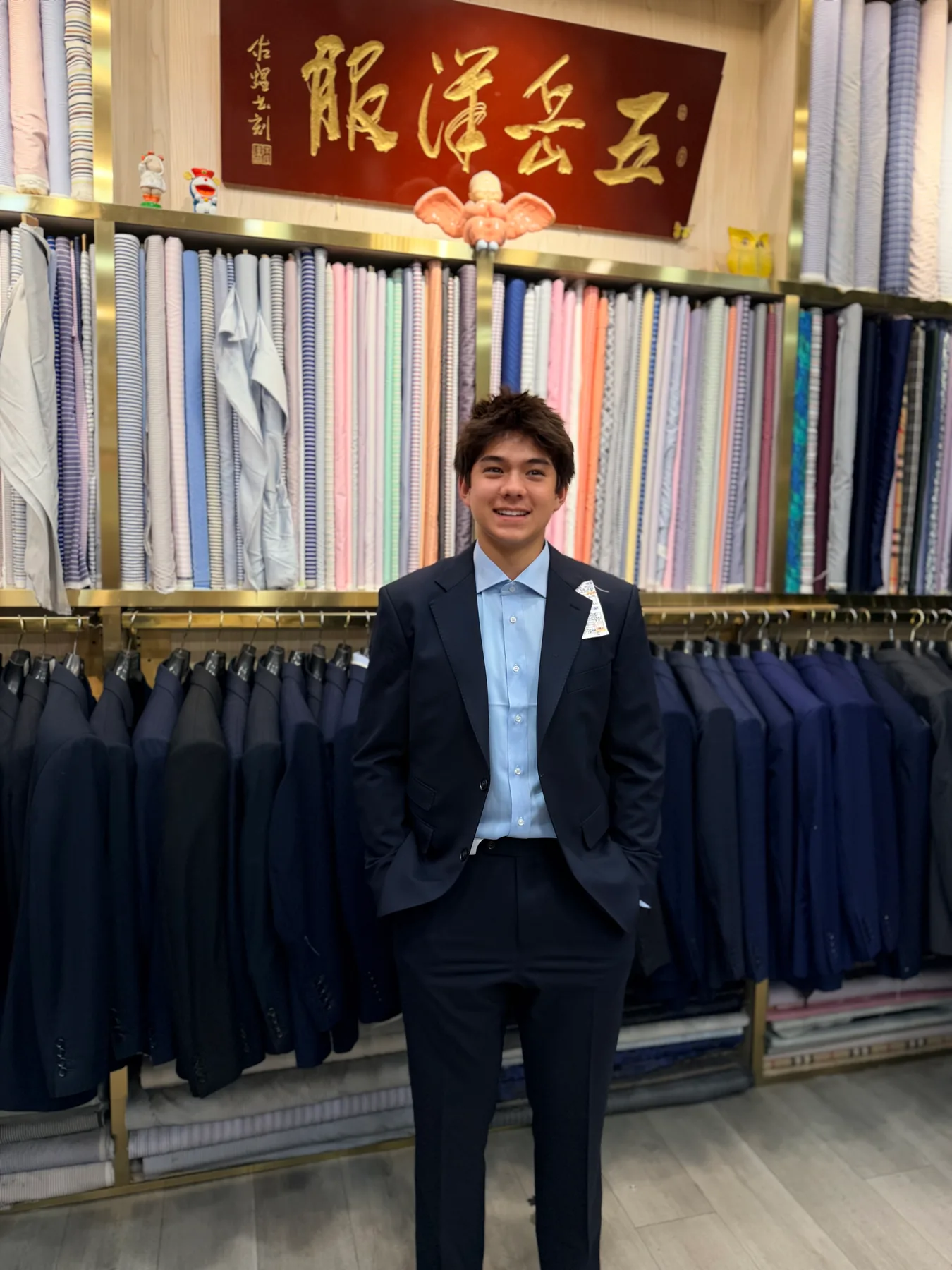
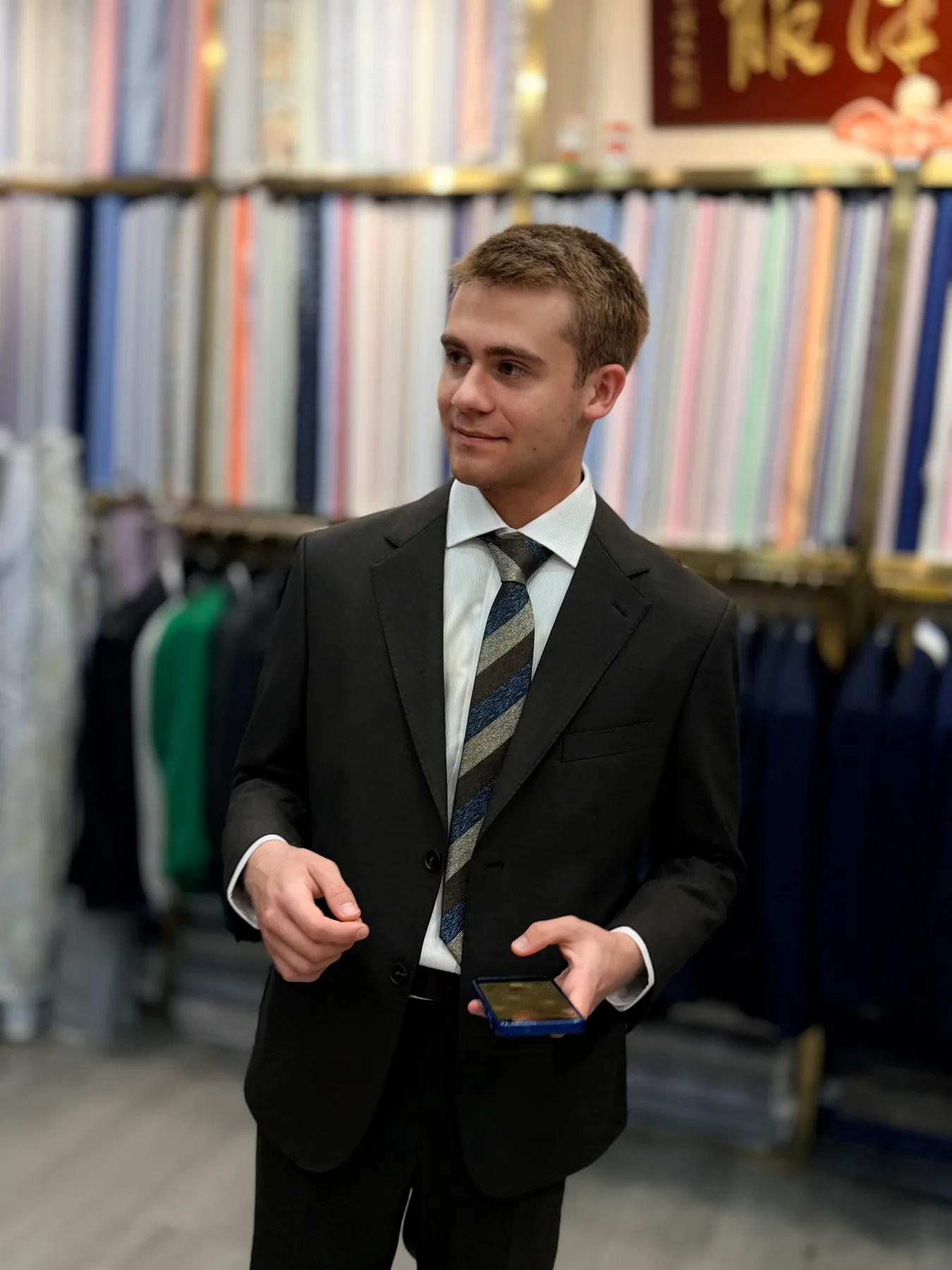
The two young clients pictured below show different finished combinations: navy with an open-collar pale-blue shirt, and a dark suit with a white shirt and striped tie. Compare the shirt and neckwear choices, then test the full outfit against your own dress code.
When a suit jacket works separately from its trousers
Two finished outfits on young Wuyue clients
A navy suit worn without a tie and a dark suit with a striped tie, photographed on two young clients in our Shanghai shop.
Check the expensive-to-change fit points first
Try the jacket and trousers together with a suitable shirt and the shoes you intend to wear. Stand naturally, without pulling your shoulders back for the mirror. Then sit and walk. Tell the fitter where you feel pressure instead of asking only whether the suit looks slim enough.
- Shoulders and collar: look for a balanced shoulder line and a collar that sits close to the shirt; ask about visible gaps, dents or bunching.
- Chest and closure: button the jacket as intended and check for pulling across the front. You should be able to breathe comfortably.
- Jacket length and balance: view the front, side and back. Do not buy an unsuitable length on the assumption that shortening will be simple.
- Trouser rise and seat: sit fully in a chair and check whether the waistband, seat or crotch pulls. A loose waist is not the only possible cause of poor trouser fit.
- Sleeves and hems: mark them with the actual shirt and shoes, then ask which adjustments are included and whether the construction limits them.
- Movement: take a few steps and reach forward gently. Explain any restriction, while remembering that a structured jacket moves differently from sportswear.
Choose fabric for where you will wear the suit
Tell the seller about your usual climate, commute and indoor conditions. A suit for a warm graduation ceremony outdoors has a different job from one worn through a cold-weather commute and an office day. Consider the cloth's weight, weave and lining together, and read its composition and care labels.
For repeat formal wear, compare a practical wool or wool-blend option with alternatives in your budget. Ask how the actual cloth handles creasing and regular use. A high Super number, an imported label or the softest sample does not by itself establish that it is the best choice for your routine.
Keep the first decision manageable: compare two or three suitable fabrics in the colour you want. Spend on a usable fit and a complete outfit before adding decorative details or ordering extra garments.
Build one complete outfit and test it before the event
A white or pale-blue shirt is a useful starting point for many conventional suit outfits. Check the collar when fastened if you will wear a tie, and check that the shirt stays comfortable when seated. Shoes should be appropriate to the event and comfortable enough for the time you will spend standing.
Keep accessories simple while you learn what you enjoy wearing. A tie may be appropriate for one interview and unnecessary for another setting. Check a belt with the trouser design, choose socks that work when seated, and try the entire combination on before deciding that another accessory is needed.
For graduation, confirm your institution's guidance and try the outfit under the gown if possible. For an interview, practise sitting with the jacket and carrying whatever you will take. These small rehearsals expose problems that a quick mirror check can miss.
Leave time for the final check, not just the purchase
Work backwards from the day you need the outfit. Leave a return visit for alterations and a final try-on, then check the complete outfit again after the work is finished. If the deadline is close, an available ready-made or rental option may be more practical than starting an unconfirmed custom order.
Once you have the suit, use a supportive hanger, let it air after wear and follow the care label. Check the pockets before storing it. Ask about cleaning and pressing rather than assuming it needs dry-cleaning after every outing.
If your first-suit shopping happens during a Shanghai visit
Use the same decisions in Shanghai: purpose, complete budget, fit and deadline. A visitor order also needs travel dates, the appointments you can attend and a collection or delivery plan. Ask for those details before comparing headline prices.
At Wuyue, start by explaining when and where you will wear the suit, what you already own and what tends not to fit. Our pricing guide gives a planning range; the garment, fabric and fitting arrangements determine the actual quote. A shop visit can help you decide whether custom tailoring fits the need, but it should not pressure you into a larger wardrobe order.
Review Shanghai suit pricing and what affects the quoteCheck your available fitting windowExplore Wuyue's custom suit service
Take this five-line brief when you shop
A clear brief makes it easier for a shop, rental service or tailor to show you relevant options. Write the answers before visiting and keep your total budget visible during the conversation.
Need a fitting plan?
Share your travel dates and garment idea before you visit.
- I need the outfit for these events, on these dates, with these dress requirements.
- My maximum for the complete outfit is this amount, including any alterations.
- I already own these shirts, shoes and accessories, and can bring them to try on.
- These are the areas where clothes usually feel tight, loose or uncomfortable.
- I can return on these dates, and I need the finished outfit by this deadline.
Sources
- Harvard Mignone Center for Career Success: Professional Attire GuideIndustry and employer context, differing expectations for networking and interviews, and comfort. This is career guidance, not an endorsement of a tailor or purchase.
- University of Pennsylvania Career Services: professional clothing supportA 2022 example of student clothing assistance. Check current programmes and eligibility with your own institution.
- Wuyue client case: American client in a navy suitDocumented client age and finished outfit; no first-purchase or event-purpose claim.
- Wuyue client case: French student in a dark suitDocumented student context and finished outfit; no graduation or interview outcome claim.
Plan your visit